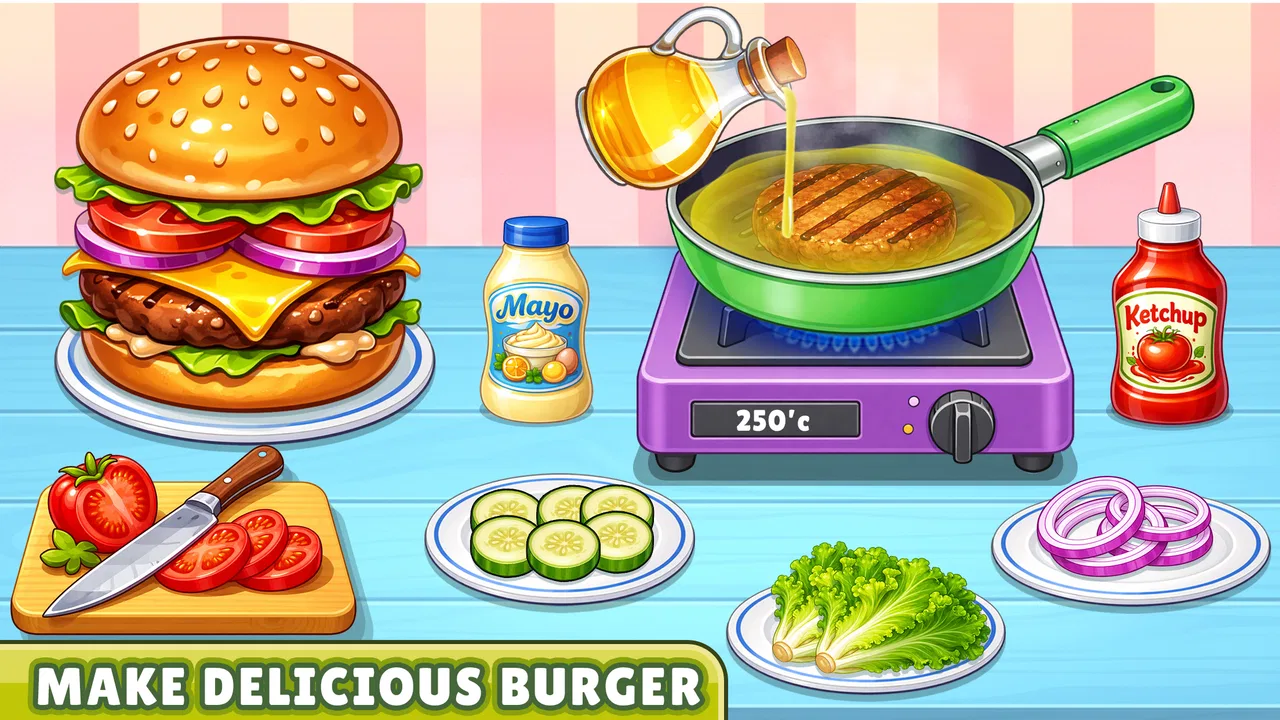
kitchen Set Cooking Game Chef
- 3.5
- Rating
- 1.00M
- Installs
- Free
- Price

 Analysis by App-foxy
I approached kitchen Set Cooking Game Chef as a small role-playing cooking game rather than expecting a full restaurant-management simulation. Its basic idea is easy to understand: you step into a kitchen-themed setting, prepare food, and spend time with chef-style activities. That makes it immediately approachable, especially for younger players or anyone looking for something lighter than a long, story-heavy role-playing game.
The game is free to download, carries an Everyone age rating, and comes from Soft Skipper. It is listed for devices running Android 6.0 or later, so it should be accessible on many older phones and tablets as well as newer hardware. The current release is version 1.2, and the game has passed the one-million-install mark, which gives it a much larger audience than its very short store description might suggest.
My overall reaction is mixed but fairly positive for the right audience. I like the simple cooking theme and the low barrier to entry, but I would not recommend it to someone searching for detailed recipes, serious time-management mechanics, or a deep character progression system. It works best as a casual kitchen activity with role-playing touches, not as a replacement for more elaborate cooking games.
You May Also Like

 Blood Strike: 2.5 Anniversary
Blood Strike’s Loadouts Turn Every Drop Into a Tactical Gamble
A close look at Blood Strike’s custom loadouts: how fast access to signature weapons reshapes its battle royale rhythm, rewards preparation, and narrows the gap between fights.

 Pandora - Music & Podcasts
Pandora’s Music Is Easy to Start, but Harder to Recover
Pandora’s strength is its low-effort path from a seed to a station. Its weak spot is how much confidence it asks you to place in connection, setup, and quiet recovery.

 8 Ball Pool
 Is Built on Rivalries, Rematches, and Routine
A close look at the rivalries, rematches, shared routines, and unanswered safety questions that turn a quick pool match into a persistent mobile community.

 Samsung Music
’s Quiet Strength Is Playing What You Already Own
Its reach comes less from spectacle than from dependable access to a personal library. That simplicity is both the app’s strongest retention engine and its ceiling.

 AccuWeather: Weather Radar
AccuWeather Review: A Quick, Clear Forecast for Everyday Decisions
For everyday plans, the best forecast is the one you can understand quickly. AccuWeather makes rain timing, radar, and local conditions easy to act on, with a few trade-offs.

 Hill Climb Racing
Why Hill Climb Racing Still Turns Crashes Into One More Run
A tiny car, a bumpy hill and one more upgrade: Hill Climb Racing keeps resurfacing because its simple chaos makes every near-miss feel personal.
More From Our News Desk



What the kitchen experience feels like
The first thing that stands out is how quickly the concept communicates itself. You do not need a long explanation to understand that the kitchen is the central setting and that the chef role is the source of the fun. That clarity matters on a mobile screen, where a game that takes too long to explain can lose its appeal before the first meaningful interaction.
I found the theme particularly suitable for short sessions. A player can open the game with a simple goal in mind: spend a few minutes preparing food or exploring the available kitchen activities, then put the phone away. That is a better fit for waiting rooms, short breaks, or relaxed play before bed than a game that expects a long uninterrupted session.
At the same time, the compact concept creates a limitation. A kitchen theme alone does not guarantee variety. The enjoyment depends on how many different tasks, ingredients, or situations the game offers, and on whether those activities continue to feel distinct after the novelty wears off. I would therefore judge this title by the quality of its moment-to-moment interactions rather than by the promise of a large culinary world.
For children, the Everyone rating makes the game easier for families to consider. I still recommend that parents try it themselves first, because an age label explains suitability in broad terms but does not tell you whether the pace, interface, or spending experience matches your household’s expectations. That quick trial is especially useful when a game is intended for a child who may play without much help.
Who is likely to enjoy it
I would point this game toward players who enjoy pretend-play cooking, simple role-playing themes, and activities that can be understood without reading a complicated rulebook. It may also suit someone who wants a gentle alternative to competitive games, since the chef setting feels more relaxed than combat-focused role-playing adventures.
A realistic use case would be a child using a tablet while a parent prepares dinner. The child can engage with a kitchen activity that mirrors the setting around them, while the parent can check the game quickly rather than needing to explain a complex control scheme. Another use case is an adult who wants a harmless, low-commitment distraction and does not want to maintain a large roster of characters or learn a demanding strategy system.
I would skip it if your main reason for choosing a cooking game is to learn practical cooking. The title presents cooking as play, not as a substitute for a recipe app or a guided culinary lesson. I would also look elsewhere if you want restaurant economics, staff management, detailed ingredient planning, or a strong narrative. Those expectations belong more naturally to specialized simulation and management games.
Progress without turning the session into work
The role-playing label raises an important question: does the game feel like a progression adventure, or is it mainly a collection of kitchen activities? In my view, the safest way to approach it is to expect lightweight progression rather than the layered systems found in larger role-playing releases. The chef identity adds context and purpose, but it should not be mistaken for a deep character-building experience.
That distinction affects how long the game can hold your attention. If you enjoy repeating familiar actions while gradually becoming more comfortable with the controls, the simple structure can be relaxing. If you need constant unlocks, complex decisions, and a clear long-term objective, the same simplicity may start to feel thin.
One useful habit is to treat each session as a small challenge instead of trying to force a long play period. Play until the kitchen tasks stop feeling fresh, then take a break. This avoids the common problem where a casual game becomes tiring because the player keeps going after the interesting part of the session has ended. For this particular title, short and regular play is more sensible than marathon sessions.
Another practical tip is to let the intended player establish a comfortable rhythm before offering help. Cooking games often look obvious to an adult, but a child may be learning the relationship between tapping, selecting, and completing a task. Watching one session can reveal whether the interface feels intuitive or whether the game needs more guidance than expected.
Pressure, mistakes, and the value of a calm pace
Cooking games can create fun pressure through timers, orders, or multitasking, but not every kitchen game needs to be stressful. Here, I would approach the experience as casual first. The appeal is the chef fantasy and the hands-on theme, not necessarily the intensity of a restaurant rush.
That can be a strength for younger players and for anyone who dislikes games that punish every small mistake. A calmer structure makes it easier to experiment and understand what the kitchen expects. It also makes the game more suitable for a shared device, where different players may have very different levels of gaming experience.
The trade-off is that a lack of pressure can reduce replay value for experienced players. Once you understand the basic interaction, you may want more demanding objectives or more meaningful choices. If the game does not provide enough variation, the same accessibility that makes the opening friendly can make the later sessions feel repetitive.
I would not use the game as a test of reflexes or strategic planning. Its better use is as an approachable activity where the player can enjoy the theme without feeling that every session is an examination. That is a clear preference, not a universal advantage: families may appreciate it, while competitive players may find it too gentle.
Fairness and the question of spending
The game is free, which removes the initial purchase barrier and makes it easy to try before deciding whether it belongs on your device. I consider that a practical advantage for a casual title, particularly when the intended player is not yet committed to the cooking genre.
However, “free” does not by itself explain the complete spending experience. I do not treat the free download as proof that every part of the game is equally available without payment. A careful player should look at the purchase prompts shown on their own device and decide whether the game’s presentation feels comfortable for them or for a child using the device.
That is also why I would not describe the game as competitive or pay-to-win. Its verified positioning is a cooking role-playing game, not a multiplayer contest with a ranked economy. Without a confirmed competitive system, it would be misleading to claim that spending creates an advantage over other players. The fair conclusion is narrower: the game can be tried without an upfront purchase, while the broader spending experience should be judged from the prompts encountered during use.
For families, I suggest agreeing on a simple rule before handing over the device: play is allowed, but any purchase request requires an adult’s permission. This is more useful than assuming the Everyone rating answers every question about spending. It also keeps the conversation focused on the actual screen in front of the child rather than on guesses about how the game might work.
For adults, the same advice is easy to apply. Try the opening activities, notice whether the game interrupts the flow with purchase requests, and decide whether those interruptions are acceptable. If they are distracting, a different free cooking game with a clearer spending model may be a better choice, even if its theme is less appealing.
How it compares with familiar cooking alternatives
Compared with a recipe application, this game is more playful and less useful in the kitchen. It can encourage interest in cooking as a theme, but it should not be chosen when you need ingredient quantities, preparation instructions, substitutions, or safety guidance. A recipe tool wins for real-world cooking; this game wins for pretend-play interaction.
Compared with a restaurant-management game, it is likely to feel less focused on business decisions. Management alternatives usually appeal to players who enjoy balancing resources, planning staff, upgrading facilities, and responding to customer demand. This title is a better fit when the kitchen itself is the attraction and the player wants a simpler chef role.
Compared with a large role-playing game, the kitchen setting gives it a more specific identity but also narrows its scope. A traditional role-playing adventure may offer exploration, combat, equipment, quests, and a longer story. Choosing this game instead makes sense when you want something more contained and less demanding. It does not make sense if you are looking for a broad world to inhabit for many hours.
The most interesting comparison is with other casual cooking games. Those games often compete through speed, visual variety, or a long chain of upgrades. This title’s advantage is its direct kitchen identity and approachable tone. Its risk is that players who prioritize constant novelty may move on quickly if the available activities do not evolve enough for them.
Small details that affect everyday use
One non-obvious consideration is device sharing. Because the game is aimed at a broad audience and supports an older Android baseline, it may be a candidate for a family tablet or a spare phone. Before settling on that arrangement, I would check how comfortable the controls are on the larger screen and whether the intended player can reach all important interface elements without assistance.
A second consideration is supervision by observation rather than assumption. Watch whether the player understands what counts as a completed kitchen action, whether they repeatedly tap the same area, and whether they can recover from a mistake. Those observations tell you more about the game’s real accessibility than the age label alone.
A third insight is that the chef theme can work as a conversation starter. After a session, ask the player what they prepared, what step was easiest, and what they would change. That turns a short mobile activity into a small creative exercise. It does not transform the game into an educational cooking tool, but it gives the theme more value than simply handing over the phone.
A fourth trade-off concerns expectations around updates. The installed version is 1.2, so I would keep the experience grounded in what is available now rather than assuming that future releases will add missing depth. If the current activities already feel enjoyable, that is a sound reason to play. If you are waiting for a more advanced system, choose based on the present version instead of an imagined expansion.
What I would check before recommending it
My first check would be the opening flow: can a new player begin cooking without repeated confusion? My second would be variety: after the first few sessions, do the activities still feel meaningfully different? My third would be the balance between play and prompts, especially when the device belongs to a child.
I would also pay attention to session length. If the game remains pleasant for short visits but becomes repetitive when played continuously, that is not necessarily a failure. It simply defines the right use. Many casual games work best as small breaks, and forcing them to serve as a main long-term game often creates disappointment.
The public response gives the game an average rating of 3.5 from around 634 ratings, with a small number of written reviews. I read that as a reason to keep expectations measured rather than as a reason to dismiss the title. The rating suggests that the experience will not satisfy everyone, and the limited written discussion means your own first session is especially important when deciding whether the controls and pacing suit you.
My trust verdict for the right player
Soft Skipper’s game is easiest to recommend when the request is specific: “I want a free, family-friendly kitchen game with a chef theme that I can try in short sessions.” For that purpose, it has a clear identity, a low entry cost, and an accessible age classification. The one-million-plus install count also shows that it has reached a substantial mobile audience.
I would be more cautious with a player who asks for depth. The role-playing category may sound broader than the actual kitchen-focused experience, so expectations matter. Do not install it expecting a full culinary simulator, a recipe reference, a competitive ladder, or a story-driven adventure. Those are different needs, and another category will serve them better.
My recommendation is therefore conditional but genuine. Try it if you enjoy simple chef role-play, want something suitable for casual family use, and are comfortable judging the spending prompts on your own device. Skip it if you need practical cooking instruction, complex restaurant strategy, or a long progression system. The best reason to play is its approachable kitchen fantasy, not a promise of deep simulation.
After trying it, I would make the final decision based on three things: whether the intended player understands the interactions quickly, whether the activities remain enjoyable after the novelty of the kitchen wears off, and whether the free-to-play presentation feels acceptable. If all three answers are yes, this modest cooking game can earn a place in a casual rotation. If even one answer is a firm no, a recipe app, management game, or deeper role-playing alternative will probably be a better match.
FAQs for kitchen Set Cooking Game Chef
01What is Kitchen Set Cooking Game Chef?
Kitchen Set Cooking Game Chef is a casual cooking simulation game where you prepare recipes, serve customers, and manage different kitchen activities. Players can usually follow step-by-step instructions, combine ingredients, cook meals, and complete timed challenges. Its simple controls and colorful presentation make it suitable for players who enjoy relaxed restaurant and food preparation games.
02Is Kitchen Set Cooking Game Chef free to download and play?
The game can generally be downloaded and played without an initial purchase, although availability may depend on the Android or iOS store in your region. Like many free cooking games, it may include optional in-app purchases for coins, boosters, ingredients, or other upgrades. Check the store listing carefully before downloading, especially if children may use the device.
03Does the game require an internet connection?
Some basic cooking levels may work without a continuous internet connection, but certain features can require online access. Advertisements, cloud saving, events, updates, rewards, and in-app purchases may not function correctly offline. If you plan to play while traveling or with limited mobile data, test the game in airplane mode first because offline support can vary by version.
04Is Kitchen Set Cooking Game Chef suitable for children?
The game is generally easy to understand because it uses tapping, dragging, and simple visual instructions rather than complicated controls. However, parents should review the age rating, advertising content, and available purchases before allowing children to play. If the game displays third-party ads or offers paid items, parental controls and purchase restrictions are recommended.
05What devices are compatible with Kitchen Set Cooking Game Chef?
Compatibility depends on the specific version published for Android or iOS, as well as the operating system requirements set by the developer. Before installing, check the official store page for supported devices, required storage, and the latest update date. Older phones may run the game less smoothly, particularly during busy kitchen scenes or when advertisements load.
Pros
- Simple controls make cooking tasks easy to learn.
- Varied recipes keep the kitchen challenges engaging.
- Bright visuals make the game appealing to younger players.
- Short levels suit quick gaming sessions.
- Progression encourages players to unlock new cooking content.
Cons
- Some stages may feel repetitive after extended play.
- Ads can interrupt gameplay between cooking sessions.
- Advanced upgrades may require considerable in-game currency.
- The game may offer limited depth for experienced players.
- Performance can vary on older Android or iOS devices.

kitchen Set Cooking Game Chef
Gallery